
Skat is a German card game for 3 players.
In each round, one player is the declarer and plays alone against the other two, who form the team of defenders. It is usually played with a 32-card deck, with cards ranked from 7 through ace.
Choose a deck of cards
Aim of the game
The player's objective is to become the declarer during the bidding phase, choose a game type, and fulfill its conditions to win the round. Only the declarer can score or lose points in that round.
In Suit and Grand games, the declarer wins the round by scoring at least 61 card points in the tricks they take.
In Null games, the objective changes: the declarer must lose every trick to win.
In addition, to win the round, the declarer must cover the bid with a game value equal to or greater than the winning bid.
Value of the cards
| Image | Card | Value |
|---|---|---|
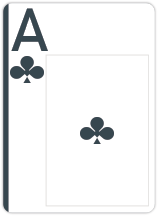 |
Ace | 11 |
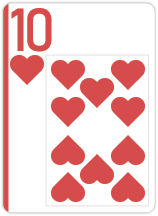 |
10 | 10 |
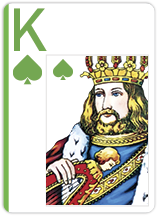 |
King | 4 |
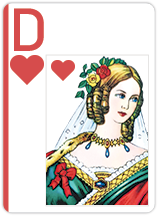 |
Queen | 3 |
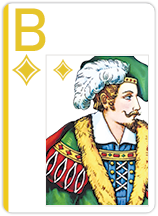 |
Bube (jack) | 2 |
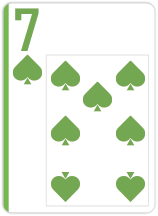 |
7, 8, 9 | 0 |
A card’s point value does not determine who wins the trick. The winner is determined by the suit led, any trumps played, and the card ranking. A card’s point value also does not determine how many points the player scores at the end of the round.
Dealing the cards
A player is chosen at random to deal. Each player is dealt 10 cards. Two additional cards are placed face down on the table; these are called the Skat.
The traditional deal is: first 3 cards to each player, then 2 cards to the skat, then 4 cards to each player, and finally 3 more cards to each player.
The bidding
The bidding determines who will be the declarer. This is the player who wins the bidding and must meet the round’s objectives.
Bidding usually starts at 18, and players take turns accepting increasingly higher bid values.
If a player does not want to or cannot match the proposed value, they pass and drop out of the bidding.
Bid values are not arbitrary numbers, as they correspond to possible game values. For example: 18, 20, 22, 23, 24, 27, 30, 33, 35, 36, 40, 44, 45, 46, 48, 50…
The player who wins the bidding becomes the declarer. They must then decide what to do with the skat and which game type they want to play.
The skat
The skat consists of the 2 cards placed face down on the table. After winning the bidding, the declarer decides what to do with them:
- Pick up the skat: the declarer looks at the 2 cards, adds them to their hand, and discards 2 cards face down.
- Play from hand: the declarer does not look at the skat cards and plays with their original 10 cards.
In both cases, the skat cards and any discarded cards count for the declarer at the end of the round.
Game type
The declarer must choose one of these game types:
- Suit game
-
The declarer chooses one suit as trump. The 4 Jacks are also trumps and are the highest trumps. The card order from highest to lowest is:
B♣ B♠ B♥ B♦ → A 10 K D 9 8 7 - Grand game
- In this game, only the 4 Jacks are trumps. There is no trump suit. The base value of Grand is 24. The card order is the same as in a suit game.
- Null game
-
The declarer’s objective is to take no tricks. There are no trumps. The card order changes:
A K D B 10 9 8 7
Declarations
Announcements increase the game value, but they also give the declarer a more difficult objective to meet.
The declarer must play from hand (without looking at the Skat cards) to make announcements at the start of the round. The following announcements are available:
- Schneider: the defenders must not score more than 30 points.
- Schwarz: the declarer wins every trick.
- Open (Ouvert): the declarer plays with their cards face up.
Game play
Play proceeds clockwise. Forehand—the player to the dealer’s left—leads the first trick.
The other players must follow suit, meaning they must play a card of the same suit as the card led. If they cannot follow suit, they may play any other card.
The trick is won by:
- The highest trump card.
- If no trump card is played, the highest card of the suit led.
The player who wins the trick leads the next one.
End of the round
After all 10 tricks have been played, each side’s card points are totaled. The Skat cards and discarded cards also count toward the declarer’s total.
- In Suit and Grand games, the declarer wins if they score 61 card points or more and the game value covers the bid.
- The defenders win if they score 60 points or more, or if the declarer does not reach the value needed to cover the bid.
- In Null games, the declarer wins by taking no tricks. If they take even one trick, they immediately lose the round.
Game value
The game value is calculated with the following formula:
Game value = Base value × Multipliers
Each game type has a different base value. Null games have fixed values and do not use multipliers.
| Game type | Game value |
|---|---|
| Diamonds | 9 |
| Hearts | 10 |
| Spades | 11 |
| Clubs | 12 |
| Grand | 24 |
| Null | 23 |
| Null Hand | 35 |
| Null Ouvert | 46 |
| Null Ouvert Hand | 59 |
Examples of minimum values needed to cover a bid:
- Bid of 18 → Diamonds game (9 × 2)
- Bid of 20 → Hearts game (10 × 2)
- Bid of 22 → Spades game (11 × 2)
- Bid of 23 → Null game (Fixed value)
- Bid of 24 → Clubs game / Grand (12 × 2 / 24)
- Bid of 27 → Diamonds game (9 × 3)
- …
Multipliers
The multiplier can increase based on the number of Tops and other game factors.
Tops are the highest trump cards in an uninterrupted sequence, starting with the Jack of clubs.
- If the declarer has the Jack of clubs, the uninterrupted sequence of highest trumps they hold is counted. This is called playing “with” Tops.
- If the declarer does not have the Jack of clubs, the uninterrupted sequence of missing highest trumps is counted up to the first trump they do have. This is called playing “without” Tops.
Simplified table of Jacks:
| B♣ | B♠ | B♥ | B♦ | Multiplier |
|---|---|---|---|---|
| ✅ | ✅ | ✅ | ✅ | +4 (with 4) |
| ✅ | ✅ | ✅ | ✖️ | +3 (with 3) |
| ✅ | ✅ | ✖️ | - | +2 (with 2) |
| ✅ | ✖️ | - | - | +1 (with 1) |
| ✖️ | ✅ | - | - | +1 (without 1) |
| ✖️ | ✖️ | ✅ | - | +2 (without 2) |
| ✖️ | ✖️ | ✖️ | ✅ | +3 (without 3) |
| ✖️ | ✖️ | ✖️ | ✖️ | +4 (without 4) |
In a suit game, the trump sequence continues after the B cards with the remaining cards in the trump suit. Therefore, the Tops multiplier can be as high as 11.
Extra multipliers
The following plays each add +1 to the multiplier:
| Play | When it applies | Mult. |
|---|---|---|
| Game | Always | +1 |
| Hand game | The declarer does not look at the skat. | +1 |
| Schneider | The defending side scores 30 points or fewer. | +1 |
| Schwarz | The defending side does not win any tricks. | +1 |
| Schneider announced | Only in a hand game; declared before play begins. | +1 |
| Schwarz announced | Only in a hand game; declared before play begins. | +1 |
| Ouvert | The declarer plays with their cards face up and must win every trick. | +1 |
Calculation example. The declarer plays spades, with a base value of 11. They have the Jack of clubs and the Jack of spades, so they play with 2 Tops. They also play from hand and win with Schneider.
- Tops: +2
- Game: +1
- Hand game: +1
- Schneider: +1
Game value: 11 × 5 = 55 points
Round result
If the declarer wins, the game value is added to their score. For example, if they play spades with a multiplier of 3, they score 33 points.
If the declarer loses, twice the game value is deducted from their score. For example, if they lose that same spades game with a value of 33, they score -66 points.
If the declarer has overbid (the final game value does not cover the bid), they automatically lose, even if they score 61 card points or more.
The overbidding penalty is calculated using the lowest game value that would have covered the bid. This value is doubled and deducted from the player’s score. For example, if the lowest possible game value were 40, they would score -80 points.
If the declarer announces Schneider or Schwarz but fails to fulfill the announcement, they lose the game. The same applies in Null games if they take a trick. In both cases, they are penalized twice the game value they would have scored for a win.
End of the game
The player with the most points wins.
In the event of a tie, the following criteria apply in order:
- More rounds won as declarer.
- Fewer rounds lost as declarer.
- Position at the start of the game, in the following order: forehand, middlehand and dealer.
Experience points and ranking
The ranking of this game will start when the betatesting period ends.